When to Fertilize Your Lawn: A Complete Guide to Timing, Frequency, and NPK
Why Your Lawn Is Basically Always Hungry
If your lawn could talk, it would probably ask for snacks…constantly.
Fertilizing is how you give it exactly what it needs to stay green, thick, and healthy.
Many homeowners either overdo it or ignore it completely.
The result is usually a patchy, dull lawn that never quite looks “finished.”
This guide breaks down everything you need to know in simple terms.
By the end, you’ll know when to fertilize, how often, and exactly what to use.
Why Fertilizing Matters More Than You Think
Grass is constantly growing, repairing, and competing with weeds.
Without nutrients, it simply can’t keep up.
Fertilizer provides essential elements that soil often lacks.
These nutrients fuel root growth, color, and overall resilience.
A well-fed lawn crowds out weeds naturally.
It also handles drought, heat, and foot traffic much better.
Think of fertilizer like fuel for performance.
No fuel means no growth.
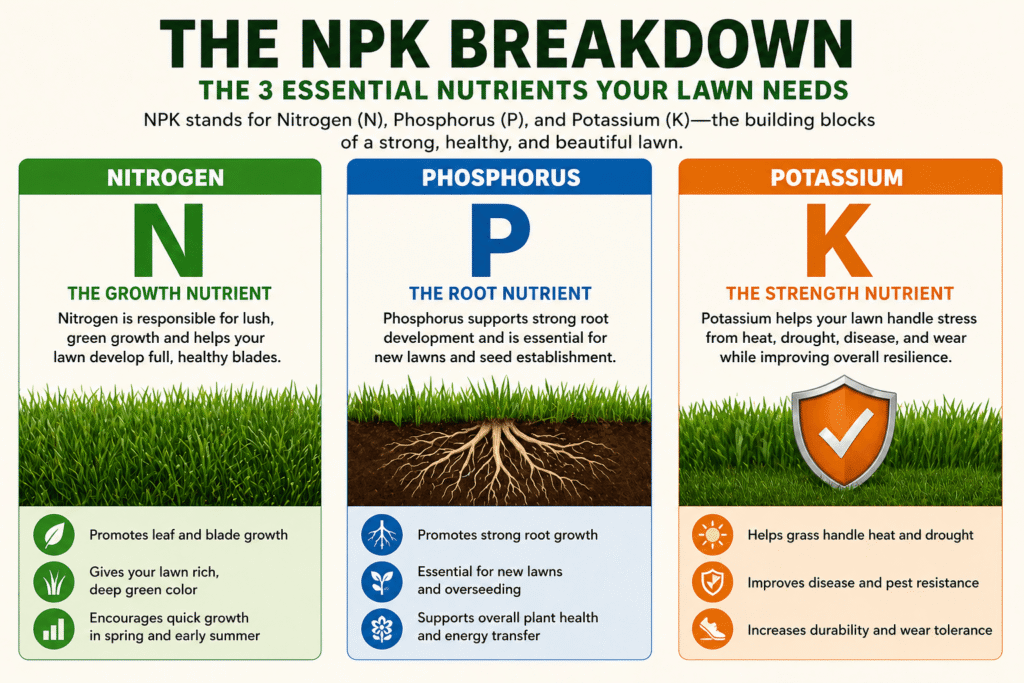
The Big Three: Understanding NPK
You’ve probably seen fertilizer bags labeled with three numbers.
Those numbers represent Nitrogen (N), Phosphorus (P), and Potassium (K).
Nitrogen (N): The Green Machine
Nitrogen is responsible for that deep green color.
It also drives leaf and blade growth.
Too little nitrogen leads to pale, weak grass.
Too much can cause rapid growth and more mowing.
Phosphorus (P): Root Builder
Phosphorus supports strong root development.
It’s especially important for new lawns or recently seeded areas.
Many established lawns don’t need much phosphorus.
Some regions even restrict its use due to environmental concerns.
Potassium (K): Stress Defender
Potassium helps grass handle stress like heat and drought.
It also improves disease resistance.
Think of potassium as your lawn’s immune system.
It keeps things stable under pressure.
When Should You Fertilize Your Lawn?
Timing is everything when it comes to fertilizing.
Feed your lawn at the wrong time, and you’ll waste money and effort.
Cool-Season Grasses (Most Northern Lawns)
If you live in places like Colorado, your lawn is likely cool-season grass.
These grasses thrive in spring and fall.
Best times to fertilize:
- Early spring (March–April)
- Late spring (May–June)
- Early fall (September)
- Late fall (October–November)
Fall is the most important feeding window.
This is when roots grow the strongest.
Warm-Season Grasses (Southern Lawns)
Warm-season grasses grow most actively in summer.
They go dormant in cooler months.
Best times to fertilize:
- Late spring (after green-up)
- Summer (June–August)
Avoid fertilizing too early in spring.
The grass needs to be actively growing first.
How Often Should You Fertilize?
Consistency beats intensity.
A steady schedule produces better results than random heavy applications.
Typical Fertilizing Schedule
Most lawns benefit from 3 to 5 applications per year.
This depends on your grass type and goals.
- Low-maintenance lawn: 2–3 times per year
- Standard lawn care: 3–4 times per year
- High-performance lawn: 4–5 times per year
More isn’t always better.
Over-fertilizing can burn your lawn and harm the environment.
Slow-Release vs. Quick-Release Fertilizer
Not all fertilizers behave the same.
Understanding the difference helps you avoid mistakes.
Slow-release fertilizers:
- Feed grass over time
- Reduce risk of burning
- Require fewer applications
Quick-release fertilizers:
- Provide immediate results
- Require more frequent applications
- Higher risk if overapplied
For most homeowners, slow-release is the safer option.
It provides steady, predictable growth.
Choosing the Right Fertilizer for Your Lawn
There is no one-size-fits-all fertilizer.
The right choice depends on your lawn’s condition and the season.
Spring Fertilizer Recommendations
Spring is about waking your lawn up.
Focus on nitrogen-heavy fertilizers.
Look for something like:
- 20-5-10 or 18-6-12
These formulas promote green growth.
They help your lawn recover from winter dormancy.
Summer Fertilizer Recommendations
Summer feeding should be lighter.
Too much nitrogen can stress grass in the heat.
Look for balanced or slightly reduced nitrogen:
- 10-0-10 or 15-0-15
Focus on maintaining health, not pushing growth.
Potassium becomes more important here.
Fall Fertilizer Recommendations
Fall is your lawn’s power season.
This is when you build strength for next year.
Look for:
- 24-0-12 or similar high-nitrogen blends
Late fall “winterizer” fertilizers are especially important.
They support root development and early spring green-up.
(Image Placeholder: Bags of fertilizer labeled with different NPK ratios)
Granular vs. Liquid Fertilizer: What’s Better?
Both options have their place.
The best choice depends on your equipment and preferences.
Granular Fertilizer
Granular fertilizer is the most common option.
It’s easy to apply with a spreader.
Pros:
- Even distribution
- Long-lasting (especially slow-release)
- Beginner-friendly
Cons:
- Slower results
- Requires equipment
Liquid Fertilizer
Liquid fertilizer is applied with a sprayer.
It delivers nutrients quickly.
Pros:
- Fast absorption
- Immediate visual results
- Good for spot treatments
Cons:
- Shorter duration
- Requires more frequent applications
- Can be tricky to apply evenly
How to Apply Fertilizer the Right Way
Application matters just as much as the product itself.
Even the best fertilizer won’t work if applied incorrectly.
Step 1: Mow Before You Fertilize
Cut your grass a day or two before applying fertilizer.
This allows nutrients to reach the soil more easily.
Step 2: Use the Right Spreader Settings
Follow the instructions on the fertilizer bag.
Too much product can burn your lawn.
Always calibrate your spreader.
Consistency is key.
Step 3: Apply Evenly
Walk at a steady pace.
Overlap slightly to avoid streaks.
Uneven application leads to patchy growth.
You’ll notice stripes for the wrong reasons.
Step 4: Water It In
Most fertilizers need water to activate.
Lightly water your lawn after application.
This helps nutrients reach the root zone.
It also reduces the risk of burning.
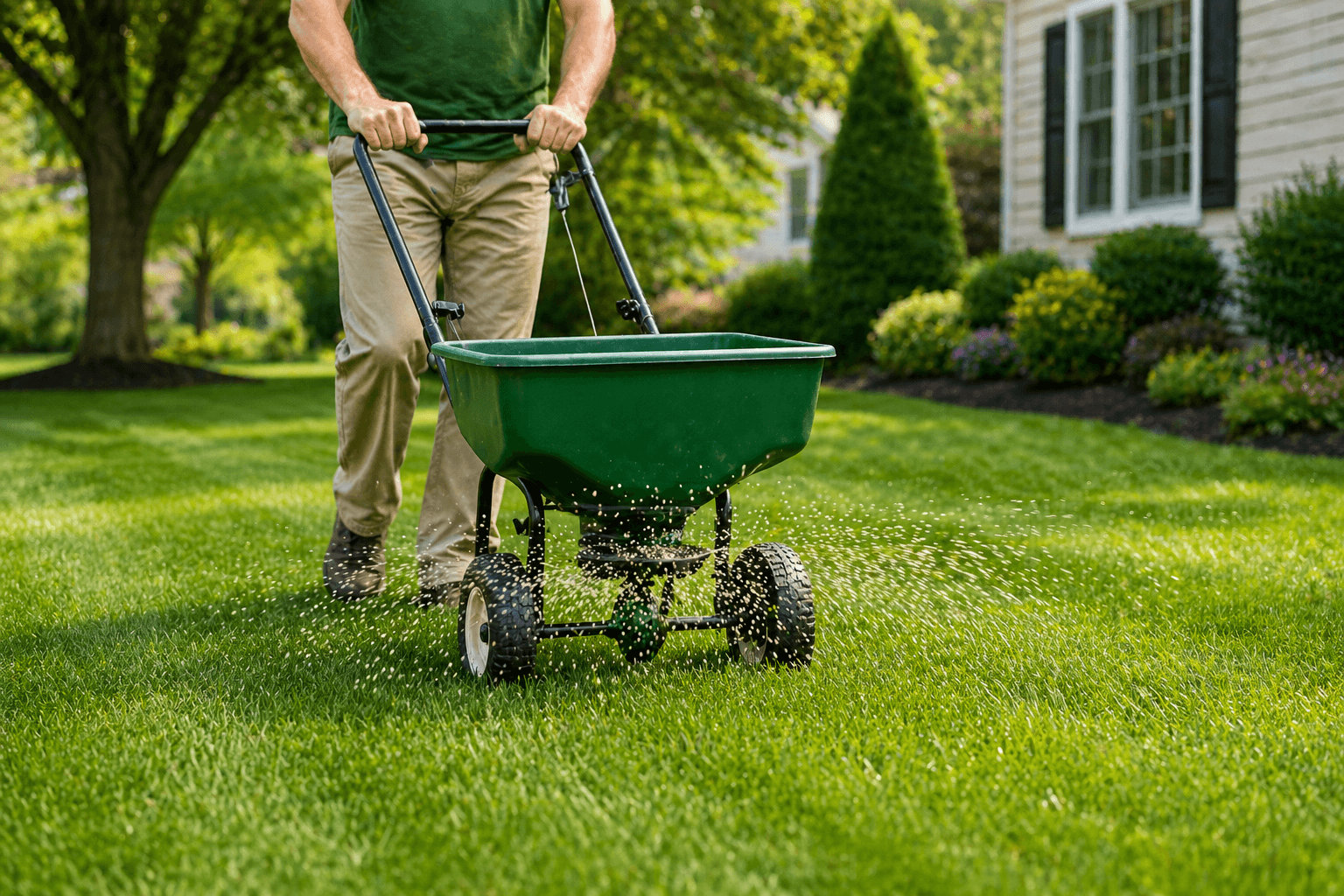
(Image Placeholder: Person using a spreader to fertilize a lawn evenly)
Common Fertilizing Mistakes to Avoid
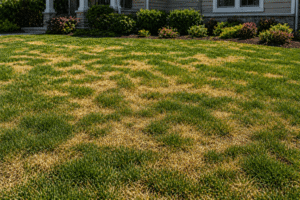 Even well-intentioned homeowners make mistakes.
Avoid these pitfalls to keep your lawn healthy.
Over-Fertilizing
More fertilizer does not mean more growth.
It often leads to burned grass and wasted money.
Fertilizing at the Wrong Time
Feeding dormant grass is ineffective.
Always align with your grass’s growth cycle.
Ignoring Soil Health
Fertilizer isn’t a cure-all.
Healthy soil is the foundation of a great lawn.
Consider a soil test every few years.
It helps you tailor your approach.
Skipping Watering
Dry fertilizer sitting on grass can cause damage.
Watering helps distribute nutrients properly.
Organic vs. Synthetic Fertilizer
This is a common debate in lawn care.
Both options can be effective.
Organic Fertilizer
Organic fertilizers come from natural sources.
They improve soil structure over time.
Pros:
- Environmentally friendly
- Supports soil biology
- Lower risk of burning
Cons:
- Slower results
- Often more expensive
Synthetic Fertilizer
Synthetic fertilizers are chemically formulated.
They provide precise nutrient delivery.
Pros:
- Fast results
- Widely available
- Cost-effective
Cons:
- Can harm soil over time
- Higher risk of overuse
Pro Tips for a Next-Level Lawn
Want your lawn to stand out in the neighborhood?
These small tweaks make a big difference.
- Fertilize in the morning or evening
- Avoid fertilizing before heavy rain
- Keep fertilizer off sidewalks and driveways
- Combine fertilizing with aeration for better results
- Stick to a consistent schedule
Consistency beats perfection.
A little effort done regularly goes a long way.
Feed Your Lawn, Reap the Rewards
A healthy lawn doesn’t happen by accident.
It’s the result of consistent, informed care.
Fertilizing at the right time and with the right product makes all the difference.
It transforms your lawn from average to impressive.
Start simple and build a routine that works for you.
Your lawn will reward you with thicker growth, deeper color, and fewer problems.
And remember—your lawn isn’t just grass.
It’s the first thing people notice about your home.
Feed it well.